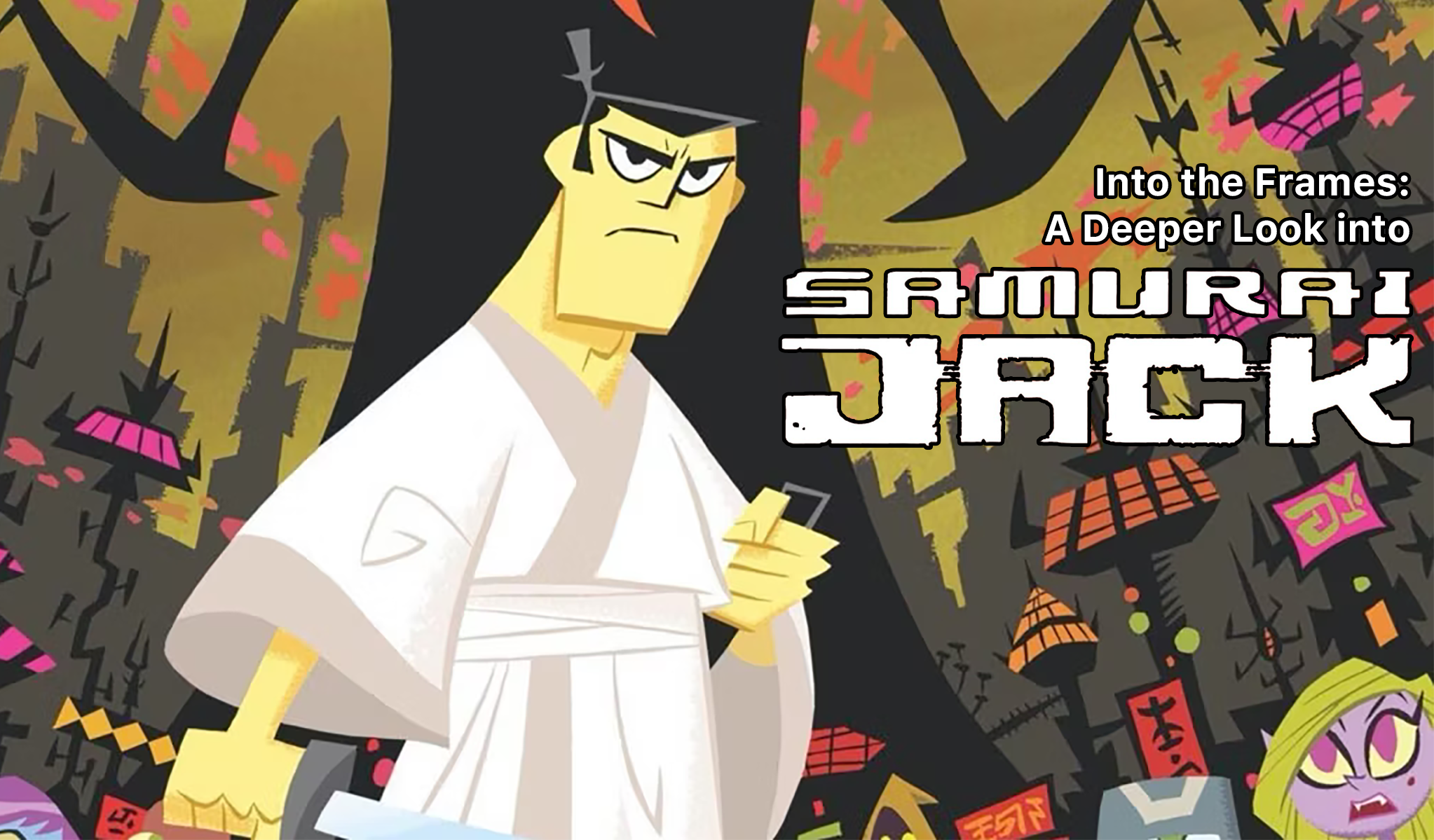
Into the Frames: A Deeper Look into Samurai Jack
By Joeseff on 15 August 2023
Welcome to the inaugural post of our new blog series titled "Into the Frames," where we delve into various animated series and movies.
Picture yourself as a child engrossed in the world of zany, slapstick-filled shows like Johnny Bravo's comical attempts at wooing, or the adventures of a pink dog named Courage facing terrifying monsters. Amidst these, a new series grabs your attention – one that brings themes from a different culture. A series promising an action-packed saga of an ancient warrior's battle against a shapeshifting demon! Animated shows with sword fights and diverse characters aren't familiar territory, but your curiosity drives you to give it a shot: the show is none other than "Samurai Jack."
"Samurai Jack" is an American animated action-adventure dystopian television series created by Genndy Tartakovsky. It distinguishes itself with its unique art style, resembling Japanese ukiyo-e, utilizing comic book-like framing akin to Japanese anime and manga, and featuring lineless characters that seamlessly blend into the background. The show aired for four seasons, each comprising 13 episodes, on Cartoon Network from August 10, 2001, to September 25, 2004. More than a decade later, the fifth season emerged on March 11, 2017, on Adult Swim, venturing into more mature themes.
Tartakovsky's inspiration for "Samurai Jack" stemmed from his childhood fascination with samurai culture and the bushido code. The series' premise aligned with his recurring dream of navigating a post-apocalyptic Earth with a samurai sword, combatting mutants alongside his crush. His fascination deepened as he delved into the rich history of samurai culture. Now, looking past nostalgia, let's evaluate how well this series holds up.
For my assessment of "Samurai Jack," I've based my judgment on select episodes: the series opener, the final episode of season 4, and the highest-rated episode pre-season 5. This approach lets me evaluate the series before the later season, which, according to IMDB, should represent an improvement. Additionally, since season 5 carries a TV-14 rating, I review it separately. Saving the highest-rated episode for last helps counter my tendency to be biased by pre-existing reviews. I've conducted a similar review for the first, last, and highest-rated episodes of season 5. Spoilers lie ahead; proceed with caution.
The debut episode of "Samurai Jack" sets the stage, introducing the main character's predicament. While the protagonist remains nameless, we know he's the shogun's son. Some character movements seem stiff – for example, the scene where the mother rows the boat away from Aku's destruction. However, the most captivating aspects are the textures of both the background and the characters. In contrast to the bold, vibrant palettes of other 2000s cartoons, "Samurai Jack" captures the essence of a moving Japanese painting, with nods to ukiyo-e art in its portrayal of the shogun's history. The episode stands out for its minimal dialogue, focusing on action, scenic changes for exploration, and music that complements varying scenarios. It's intriguing to watch the main character navigate diverse cultures and training styles as he embarks on his journey.
The final episode of season 4 proves underwhelming without context. One might wonder, "Is this truly the end?" Notably, both the opening and closing episodes of season 4 involve Jack's exploration of future realms in quick succession, mirroring his initial training journey in the series' first episode. Movement appears smoother, and the episode features fewer musical scores compared to the first, as action takes precedence over montages. The inclusion of Japanese folklore and characters designed in the prevalent style of that era, characterized by bold lines that set them apart from the background, is a commendable touch. Nonetheless, the episode seems neat and lacking proper closure for Jack's ongoing battle against the overarching antagonist. The series deserved a more satisfying conclusion, which was originally intended but got canceled in the early 2000s, only to be revived in 2017.
Before delving into the highest-rated episode from 2001, a sense of nostalgia envelops me as I hear the familiar jingle of "Samurai Jack's" opening and closing themes. Even the old Cartoon Network logo, resembling the clicking of an old-fashioned projector, adds to the trip down memory lane. The highest-rated 2001 episode on IMDB is the seventh installment, titled "Jack And The Three Blind Archers." Compared to the final episode, the animation might feel less fluid – this perception could stem from cherry-picking or misremembering. Unlike the bookended episodes, this one lacks an embedded tale, which positively affects the storytelling but diminishes the exposure to different cultures and fables. Nevertheless, episode 7 launches into a grand fight with well-executed sound design, intensifying the encounter with a robot viking army through music tempo, marching sounds, and machinery whirring. Emotions shine through Jack's character, from a determined warrior seeking to rectify his past to a frustrated realization that his quest for return might remain unfulfilled. Although my recent viewings are confined to the 2001 opener and finale, it's evident why episode 7 garnered high praise among the 2001 releases.
The initial episode of Season 5 marks a tonal shift for "Samurai Jack" compared to its 2001 seasons. The grittier ambiance reflects Jack's dilemma of leaving people to perish due to his inability to traverse time, delving into themes of death and showcasing Aku's sinister reign by introducing a cult devoted to him. Comprising of women, this cult's members, including a mother of seven daughters, with accelerated growth and harsh training to become instruments of Jack's destruction. The episode portrays Jack's adaptation to the future, as he wields various gear and weaponry beyond his original 2001 ensemble, from motorcycles and guns to an electrified, extendable staff and adaptable metal armor. These changes lay the foundation for an engaging 2017 season, characterizing the mature themes that audience members who grew up with the show might crave. While the new opening takes getting used to, I do miss the expressive titles featured in the 2001 seasons.
The series finale of "Samurai Jack" offers a heroic conclusion, skillfully weaving in nostalgic references to the characters Jack aided throughout his journey. The action-packed sequence serves as a reminder of these diverse characters. A bit more buildup could have enhanced the episode's impact, fostering anticipation as Jack's supporters prepared for the ultimate confrontation with Aku. However, the transition from distress over Aku's announcement to their arrival to assist Jack feels abrupt. One notable omission is the absence of a proper farewell or ceremony to commemorate Ashi's disappearance, which detracts from the emotional depth of the episode. Overall, a neat conclusion filled with nostalgia, but it just felt incomplete.
The highest-rated episode in the series, "XCIII," stands as a well-executed, action-packed installment. Jack's internal struggle is compelling, pitting his determination against his mounting doubts. Aku, too, faces an internal conflict, albeit less self-deprecating, stemming from his fifty-year wait for Jack's demise. This juxtaposition highlights Jack's resilience and adaptability, as he engages in battles both physical and mental. The episode presents a fantastic portrayal of Jack's resourcefulness and his grappling with the ethical implications of his actions, particularly when confronted with flesh-and-blood adversaries. Although I notice a discrepancy in the depiction of the last four “robots” of the final episode of the fourth season: they looked more fleshy than robotic, yet still craved meat (a being of flesh and steel wants to eat a baby?) Even when they were sliced apart, they had mechanical insides for what I assume was just for the sake of censorship for their audience at the time.
In summation, "Samurai Jack" stands as a remarkable series with a hand-drawn art style that effectively incorporates diverse cultures and folktales. Despite moments of rigid movement, the seamless integration of music and sound breathes life into each scene. The series' conclusion left some aspects wanting, with a desire for more emotional closure, particularly after Ashi's disappearance. While the journey concludes with a nostalgic nod, the ending feels somewhat lacking. Reflecting on this journey down memory lane, the completion of Jack's saga is satisfying, yet I yearn for a more profound resolution.
Rest in peace, the first voice actor for Aku: Makoto “Mako” Iwamatsu (December 10, 1933 – July 21, 2006).
The source of information about Samurai Jack came from (among others) the following:
People are at the heart of Yusha!
Join our newsletter to keep up to date with all future releases, product updates, specials, and news about Yusha!
